Richmond Sign Company Builds Big Signs that Build Big Brands!

www.holidaysigns.com-hanovens

HOW DO YOU CAPTURE AND KEEP YOUR CLIENT’S ATTENTION?  

The Value of Iconic Signs

Winding Brook & Reynolds

In the same way signs help Coca-Cola and McDonalds set themselves apart as iconic international brands, two area developers have contracted our services to erect iconic signs at their highly visible commercial developments.

BIG CATCH!
The Winding Brook Development, located on I-95 in Hanover County, is becoming a retail hot spot.  Holiday Signs provided an eye-catching entrance monument there several years ago as the new retail center developed. The twenty-seven foot high sign touts a fourteen foot high fiberglass fish promoting the cornerstone tenant, Bass Pro Shops. Two large metal signs mounted to its stone base identify the development as Winding Brook, and along with the big fish sculpture, create an unforgettable icon that provides:


  • Immediate Customer Attraction
  • Long-Term Brand-Building Resultswww.holidaysigns.com-richmond-henrico-big-signs

COMMERCIAL SCULPTURE
Collaborating with the developers of Reynolds Crossing, a retail and medical office park off I-64, we created a unique entrance sign. The finished sign, taking the form of a large modern sculpture, conveys the corporate brand and took the ideas and workmanship of a talented staff to complete. A small-scale prototype was produced prior to manufacture so both the customer and the craftsmen understood the ultimate outcome. Being able to manufacture the complex compound curves of the sign’s design elements without a flaw was truly an art that few area sign companies can achieve. The iconic sign:

  • Impacts passengers of 36,000 vehicles daily
  • Impresses millions over its lifetime due to its enduring and eye-catching design

THINK BIG!
www.holidaysigns.com-richmond-virginia-reynolds-crossing-development-signs-iconic-entriesScientific studies show that the few select brands considered iconic enjoy a 58% top-of-mind awareness for customers versus a 36% awareness for those considered just strong brands.

  • Iconic Brands become “super-familiar” versus just “familiar”
  • “Super-familiar” brands are more likely to be considered for purchase over competing “familiar” brands

Signs as part of a company’s regional branding efforts can become icons very quickly. With over 8 million sets of eyeballs right here in Virginia it pays to think big!


Contact: Mark Hackley, mhackley@holidaysigns.com

Account Executive, Holiday Signs  540-416-3154


 Click Here for More Technically Challenging Sign Project

CASE STUDIES


printer friendly icon


Here are some other articles of interest about signage in VA, MD, DC and NC:


  • Technically Challenging Sign Projects

Virginia Iconic Signs

Why Use Sign Prototypes?

Case Study: Hotel John Marshall

Historic Restoration Case Study

Powerful Entrance to a Virginia Mixed Use Development


  • Branding & Wayfinding Signs

What is the Cocooning Effect?

Shopping Center Repositioning

Roanoke Airport’s new Wayfinding System

Re-Branding a Retirement Community

Turning Eyeballs into Smiles


  • Digital Messaging Signs

Case Study: Towne Center West’s Digital Advertising Sign

Case Study: Green Top Sporting Goods’ Electronic Message Center on I-95

Using Co-op Dollars to Fund Digital Signage

Using Digital Signs to Connect with the Community

10 Reasons to Upgrade to On-Premise Digital Advertising


  • General Signage

6 Reasons to Retrofit Neon to LED

Consideration of Sunlight and Shadow in Signage Design

Consideration of Viewing Angle in Signage Design

Sign Illumination Choices

How Can Specialty Sign Lighting Techniques Position Your Brand?


Potential Problems with Channel Letters

www.holidaysigns.com-richmond-va-channel-letters

Channel Letters: Effective

vs Ineffective Design  

Part 1- Potential Problems with Channel Letters- Contrast

Example 1


3-D IMAGES

Customers will often come to us for help with channel letters. “Channel letters” is the term for three-dimensional fabricated letters and logos that light up internally.

MANY SHAPES AND SIZES

Sometimes they are mounted directly to the wall surface, and sometimes they are mounted on a raceway that is mounted to the wall. The “faces” of the letters are the flat parts of the fronts that usually light up at night, and the “returns” are the edges of the letters that go back to the raceway or wall. Channel letters are mostly used for retail store identification at strip centers, malls and stand-alone stores.

MULTI-INDUSTRY APPLICATIONS

They are excellent ways to brand a building, whether a jewelry store, a bank, a hotel, a restaurant or a grocery store. They are also used by hospitals to identify emergency rooms, and colleges use them to identify the buildings on campus. When designed right, the three dimensional quality of channel letters makes them eye-catching and appealing to passing pedestrian and vehicular traffic. Channel letters aren’t limited to storefront walls. They can also be utilized to add depth to otherwise monolithic monument and pylon signs.

THREE POTENTIAL PROBLEMS WITH CHANNEL LETTERS

Three elements of sign design that can make a set of letters ineffective are: (1) poor contrast between letter and wall color during day or night; (2) areas in open centers of letters that attract nesting birds; and (3) insufficient viewing angle. Many times a client will tell us, “I don’t like my current sign, but I can’t tell you why.” The skilled sign designer can immediately see the problem. Such is the case when channel letters are not designed with cast shadows in mind.

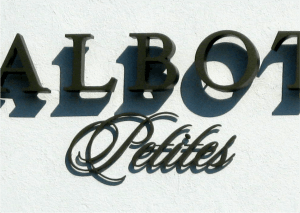
 Like with any sign, establishing the best contrast between the sign graphics and the background is the key to readability. During the morning hours on clear days, just as customers are beginning to make their way to various retailers, the sun is casting long and dark shadows on the channel letters of the world. Depending on their design, this can either create negative or positive readability. If the letter faces are white, the shadows usually help the letters pop out from a light or dark colored wall. If, however, the background walls are light color and the letters are dark without an outline, the effect of the shadows can make it nearly impossible to read because the letters and the shadows will all blend together (see example 1). The shadow challenge can be overcome by incorporating light color faces with outlines and dark returns (see example 2).

Example 2

Another design strategy of a good channel letter design is to keep the widths of letter strokes wider than the shadow it will cast so it will help with legibility in bright light and shadows. From an engineering view, wide strokes are usually necessary to economically build channel letters and install lighting evenly within them. Also, the width of the lettering affects the viewing angle at which the lettering can be read. The wider the stroke of a letter, the wider the horizontal viewing angle. Viewing angle is important for the visibility of your sign by potential customers passing at close proximity of your storefront.


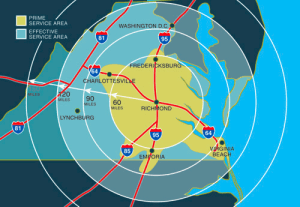
OUR SERVICE AREA

www.holidaysigns.com-richmond-va-service-area-map


NEED A SERVICE CALL FOR EXISTING CHANNEL LETTERS? (CLICK HERE)


NEED HELP WITH NEW CHANNEL LETTERS FOR YOUR STORE OR MULTI-SITE BUSINESS?  (CLICK HERE TO CONTACT A PROJECT MANAGER)


Printer-Friendly


  • If You Liked This, You May Also Like:

What is the Cocooning Effect?

Shopping Center Repositioning

Roanoke Airport’s new Wayfinding System

Re-Branding a Retirement Community

Turning Eyeballs into Smiles


What are the Risks of Digital Signs – Part 1

www.holidaysigns.com-richmond-va-daktronics-watchfire-digital-LED-signs

RISK-FREE DIGITAL MESSAGING

PART ONE- CONSIDERING THE VARIABLES

Sheehy Ford digital signs richmondThere’s a difference between marketing a business on Main Street in Waynesboro, Virginia and Broad Street in Richmond. Ask the marketing managers of any regionally focused retail chain and they will agree that each of their store locations has its own recipe for the right marketing mix. But if conditions are right for digital messaging at a particular location, shouldn’t it quickly become part of the organization’s communications strategy, just like direct mail, radio and social media?

Blog Blurbs

Having a clear picture of results limits the risks in going digital. So many times as an advertising salesperson I’ve heard customers ask, “How much more business will I realize by purchasing an electronic message center as part of my company’s marketing mix?” The answer depends on many variables, and being able to understand and control the variables is critical to the actual performance of a new digital sign.

Let’s look at three important variables involved in the decision to go digital:

First, does the monthly traffic count justify the investment? A digital sign is a form of advertising media just like newspaper, radio, TV, and social media. You wouldn’t make an investment in any media if the reach didn’t justify the cost.  One reputable traffic assessment tool we use to help clients understand the size and scope of their front-door market is the VDOT 2012 Traffic Data tool, available online. Whether you have one location or dozens, Holiday Signs’ project managers can help provide customized traffic assessments for your location(s). Once you establish a baseline market of potential sign viewers, you can determine what segment of the market you think you can reach with each new sign.

Second, can you effectively create and control compelling content so it reaches and persuades your target market to action? It’s easy for a sign company to sell and install the hardware for a digital messaging system, but generating ongoing creative content is harder. Hence, a question worthy of asking prior to purchase is: Can you as a marketer, create ongoing, eye-catching content to get the most from this dynamic form of on-premise advertising, and how can your sign company help? Holiday Signs can get you on the right track to consistently powerful content and can provide training that helps customers learn how to design and schedule winning ads.

www.holidaysigns.com-what-are-the-risks-of-digital-signs-richmond-va-nova

Third, if you have the drive-by market and the message, are you prepared for the incremental business derived from a new digital sign? Testimonials consistently show a growth in sales by adding digital messaging signs. Where the actual numbers end up depends on variables including traffic count and how well the marketer controls the sign’s content and content timing. Here is a good example of proven sales growth from adding digital signage: Ice cream sales are driven by hot weather. Dairy Queen recently implemented exterior digital messaging signs at two of 35 stores in a particular territory. Summer sales at the two locations with digital signage jumped 10-15% higher than the other stores during the same period where weather patterns were similar, and the only marketing difference was the signage. (Click the Dairy Queen link to read about the story.)

If your community codes allow digital signage, take a good look at your existing traffic count and whether or not you want to increase your business by at least 10-15% within a short time of implementing a new digital sign. If the variables seem to be in your favor and you’d like to talk more in detail with a project manager about how digital messaging could be implemented at your organization, please contact us today!

READ Part 2- An Active vs Passive Form of Advertising


printer friendly icon


6 BENEFITS OF DIGITAL SIGNS:


  • Other Articles About Digital Messaging Signs…

Case Study: Towne Center West’s Digital Advertising Sign

Case Study: Green Top Sporting Goods’ Electronic Message Center on I-95

Using Co-op Dollars to Fund Digital Signage

Using Digital Signs to Connect with the Community

10 Reasons to Upgrade to On-Premise Digital Advertising


What are the risks of digital signs ??

Airport Wayfinding Signs Improved Wayfinding Builds Positive Customer Experiences

www.holidaysigns.com-roanoke-virginia-wayfinding-signs-airportsROANOKE REGIONAL AIRPORT

Airport Wayfinding Signs

 Lionberger Construction of Roanoke, Virginia chose Holiday Signs to provide the wayfinding signs for the Roanoke Regional Airport Improvements Project in Roanoke.

Airport official Sherry Wallace said one of the biggest issues of their passengers was not being able to find the restrooms. The estimated $3.1 million renovation project included provisions for new terminal and gate directional signage, including improved wayfinding for restroom areas.

In addition to working closely with our client, Lionberger Construction, the Holiday Signs design, production, and installation teams interfaced with architects from Baker Inc., and wayfinding consultants from Valancourt International to provide new and improved signage that enhanced the renovated spaces at the airport while at the same time resolved old problems air travelers had with finding their way around.

 The project consisted of an all-aluminum system with custom brushed finishes. The ceiling mounted signs in the terminal required special equipment for installation due to the height above the floor level. Each sign type comprising the new system was prototyped and reviewed prior to construction in Richmond. Several recommendations for design improvements were suggested by Holiday Signs and worked into the final project. Signs were designed in strict accordance with ADA and FAA guidelines. Full-size scaled templates of every sign were prepared prior to final production for approval of typefaces, letter heights, spacing, and wording by the wayfinding consultant and architect.

One of the biggest challenges was the timing of the project. The airport management team had well-defined completion goals and Holiday Signs effectively coordinated design, prototypes, fabrication, security clearances for workers and final installation within very strict phasing time frames.

This phase of a multi-phase renovation project began last summer and is in the final stages of completion.

 Roanoke Airport Wayfinding Photo


Signs were designed, manufactured and installed in

accordance with strict ADA, FAA and Homeland

Security guidelines and procedures.


Printer-Friendly


  • Case Studies from Technically Challenging Sign Projects:

Virginia Iconic Signs

Why Use Sign Prototypes?

Case Study: Hotel John Marshall

Historic Restoration Case Study

Powerful Entrance to a Virginia Mixed Use Development

Energy Efficient Signage

November 2013-Technically Challenging-Hotel John Marshall 2 header

CASE STUDY:ENERGY EFFICIENT SIGNAGE

Signage Renovation at The Hotel John Marshall, Richmond, VA


Many times a building becwww.holidaysigns.com-richmond-va-high-rise-signsomes a landmark because of the sign that’s on top of it.  In Richmond, Virginia, that’s the case with the Hotel John Marshall. Several years ago, the once grand sixteen story icon had all but faded into the background of Richmond’s historic downtown in dire need of a sign restoration. In 2011, Holiday Signs got the chance to help revive it by restoring its vintage roof marquee using energy efficient signage components.

When the hotel first opened in 1929, it was the largest hotel in Virginia offering all the amenities of luxury hotels of that era. Named after Virginia’s longest serving Supreme Court Chief Justice, its marble and gold lobby, cathedral doorways and spacious stairways lured in many famous guests throughout the years. After the recent $70 million renovation, the refurbished historic hotel now houses multiple floors of residential apartments with retail and office space on the lower levels.

The sign was a historic landmark. It needed work to restore it back to its original vitality. Built years ago and abandoned in 1988, it became a ghostly reminder of its neglected past. It was rusting away. The lighting in the 34 large, 7 foot tall letters was the old incandescent bulb type. There were some 1,400 light bulbs per side which were major energy hogs always in need of maintenance. They regularly burned out and there was a big safety concern involved with changing them.

hotelJM day nightWhen the new owners took on redevelopment in 2009, they needed to make substantial energy improvements to obtain HUD funding. Holiday Signs was chosen as the best firm qualified for the sign restoration. We worked for Choate Interiors, a part of Choate Construction, the General Contractor. Even with the developer’s 3-year relationship with another sign company, we got the www.holidaysigns.com-hotel-john-marshalljob because of our technical expertise. From an owner’s point of view, we wanted to make the investment in the sign renovation economic over the lifetime of the sign: both initial cost, and operating costs of energy and maintenance. We also had to make sure the new cost-efficient signage was historically accurate.

Our creative solution replaced old incandescent bulbs with low-voltage LED lighting that looked historically correct by usingwww.holidaysigns.com-virginia-hotel-led-signs modern digital printing technology. We recommended closed face letters with printed covers that would make them look like the old open-faced bulb letters while offering the LED lighting components protection from the elements of the harsh rooftop environment. We demonstrated prototypes and then met with the Chief Architect for the National Park Service (since the hotel overlooks Richmond’s Slave Trail it is under NPS jurisdiction), and representatives from the City of Richmond and the General Contractor to tweak the digitally printed bulb designs and LED lighting placement to where all parties were satisfied with the effect.

By utilizing LED, power consumption for illumination was reduced by 70%. As an added value service, we worked with Dominion Power to get the General Contractor a substantial rebate for the huge energy reduction. Today, the renovated energy efficient signage casts an accurate image of Richmond’s bygone era while utilizing many of the benefits of modern-day sign and lighting technology in its day to day operation.

www.holidaysigns-richmond-downtown-Hotel John Marshall


     Residences at the John Marshall Website

     Photography Provided by Jim Smith/ Flying Dog Photography,

     804.543.3995


     printer friendly icon


For New Sign and Signage Restoration Inquiries, Contact: Mark Hackley, Account Executive, mhackley@holidaysigns.com


If you liked this article, you may also like:


Restoration of an Historic Richmond Theater Marquee

How Digital Messaging Can Help Shopping Centers Lure and Retain Tenants

An Important Wayfinding Term to Learn and Remember

See How One Virginia Mixed-Use Development Makes a Huge First Impression

What is Risk-Free Digital Messaging?

The Value of Sign Prototypes and Getting Things Right on the Ground


November 2013-Technically Challenging-Hotel John Marshall 2 size fixed

3 Benefits of Sign Prototypes for High-Rise Applications

www.holidaysigns.com-portsmouth-virginia-hih-rise-signs-technically-challening-channel-lettersWhen Do I Need Prototypes?      click for more technical case studies

Three Benefits of Sign Prototypes for High-Rise Applications
 
 MWV

Designing signs for high-rise applications and attaching them to buildings is not a typical capability of the average sign company. Technically speaking, there are few sign companies in Virginia that can truly handle the full gamut of signage from vinyl hours on the glass entrance doors to the huge custom electric signs that brand the tops of towers across familiar city skylines of Northern Virginia, Richmond, Tidewater and Roanoke.

Holiday Signs provided the branding signage for the MeadWestvaco (MWV) Corporate Headquarters building located at 501 South Fifth Street, Richmond, Virginia. The building’s striking design above the James River is signed with the corporate brand making the MWV building a noticeable and visually attractive addition to downtown Richmond. The project involved the design, manufacture and installation of MWV logos for three sides of the skyscraper viewed 24 hours a day.

Holiday Signs delivered considerable value to the customer by producing logo prototypes made during the course of this project. Using prototypes may seem like an unnecessary use of materials at first glance, but when considering large scale signage and costs of manufacture and installation of high-rise work, using prototypes only makes good sense.

 There are three important benefits of using sign prototypes for high-rise applications:

● Cost Reduction

Resource Conservation

● Achievement of Best Results  

Because of our experience with high-rise and other technically challenging projects, we know it’s best to get it right on the ground and get a strong sense its going in the right direction with signage prototypes before committing to build the whole thing.

The MWV corporate philosophy embraces sustainability as part of their ethical business strategy and proactively partners with vendors driven by the same commitment to sustainability. MWV consciously took steps in reducing its carbon footprint by purchasing locally, and by using LED lighting for illumination. But perhaps the biggest sustainability aspect here was the agreement to utilize prototypes in the manufacturing cycle saving at least 50% in material, labor and fuel.

The MWV logo was designed by an independent design firm. The first prototype was made based on the original design specifications. After critically viewing the www.holidaysigns.com-richmond-virginia-va-high-rise-signs-prototypesGen 1 illuminated corporate logo from the ground, a team of senior executives immediately wanted it taken down and redesigned. Both the lighting and framework were redesigned and a new Gen 2 prototype was prepared. Before this could be approved for production, a third Gen 3 prototype was ordered because MWV re-designed their logo.

Without prototypes, it would have cost more than twice as much to achieve the same end results, and would have over-used valuable resources that MWV is dedicated to conserve. Also, the prototypes helped make sure installation and future service costs were kept to a minimum. In this case, the design of channel letters for mounting on very expensive glass panels was coordinated with the architect and engineer to make sure the attached logos did not over-stress the glass or building structure. Without the use of prototypes, the customer would have incurred significant costs for the design, manufacture, installation and removal of the logos.

The completed corporate image was a big success! It fits the building and surrounding environment while making a lasting impression on the MeadWestvaco brand in Richmond!


printer friendly icon


If You Liked This Article, Here Are Some More You May Like:


  • Technically Challenging Sign Projects

Virginia Iconic Signs

Why Use Sign Prototypes?

Case Study: Hotel John Marshall

Historic Restoration Case Study

Powerful Entrance to a Virginia Mixed Use Development


  • Branding & Wayfinding Signs

What is the Cocooning Effect?

Shopping Center Repositioning

Roanoke Airport’s new Wayfinding System

Re-Branding a Retirement Community

Turning Eyeballs into Smiles


  • Digital Messaging Signs

Case Study: Towne Center West’s Digital Advertising Sign

Case Study: Green Top Sporting Goods’ Electronic Message Center on I-95

Using Co-op Dollars to Fund Digital Signage

Using Digital Signs to Connect with the Community

10 Reasons to Upgrade to On-Premise Digital Advertising


  • General Signage

6 Reasons to Retrofit Neon to LED

Consideration of Sunlight and Shadow in Signage Design

Consideration of Viewing Angle in Signage Design

Sign Illumination Choices

How Can Specialty Sign Lighting Techniques Position Your Brand?



Storefront Sign Renovations at Shopping Centers

Strip Malls, Shopping Centers need Design to Survive

June 27, 2013 by The Gaines Group – Harrisonburg Studio

Storefront sign renovations at shopping centers seems to be a hot topic in Virginia. At Holiday Signs, we seem to always have a shopping center sign rehab in the shop. It reminds me of the nurse at the plastic surgery section of the hospital telling her friends about all the patients waiting around for their new looks! We have lots of sign “patients” in Chester awaiting renovation.

I recently ate a hearty breakfast at the newly renovated Holiday Inn off I-81 in Staunton with my friends from the Greater Augusta Regional Chamber, where we discussed economic development in Augusta County, Virginia. Joining me at the table was Charles Hendricks, an architect with The Gaines Group, with offices in Harrisonburg and Charlottesville, VA.  I’d like to re-post his recent blog about a topic of interest for developers:

A great shopping experience begins with a developer, a parcel of land, and an idea.  Modern “car-friendly” strip malls became popular in the early 1920′s in the United States. The primary focus was a large parking lot with “anchor stores” to attract the customers all to one easy convenient location. This model has not really changed over the years yielding many neighborhood centers where you can easily get your groceries, a few odds and ends, and occasionally a locally owned restaurant. These car friendly destinations offer a huge value as neighborhood centers – the problem is that is not how they were designed. They do not serve as neighborhood centers, but rather offer very little value to the neighborhood or to the shopping experience. Those that are not adapting are slowly dying leaving large swaths of parking lots, empty storefronts, and developers wondering how to turn things around.

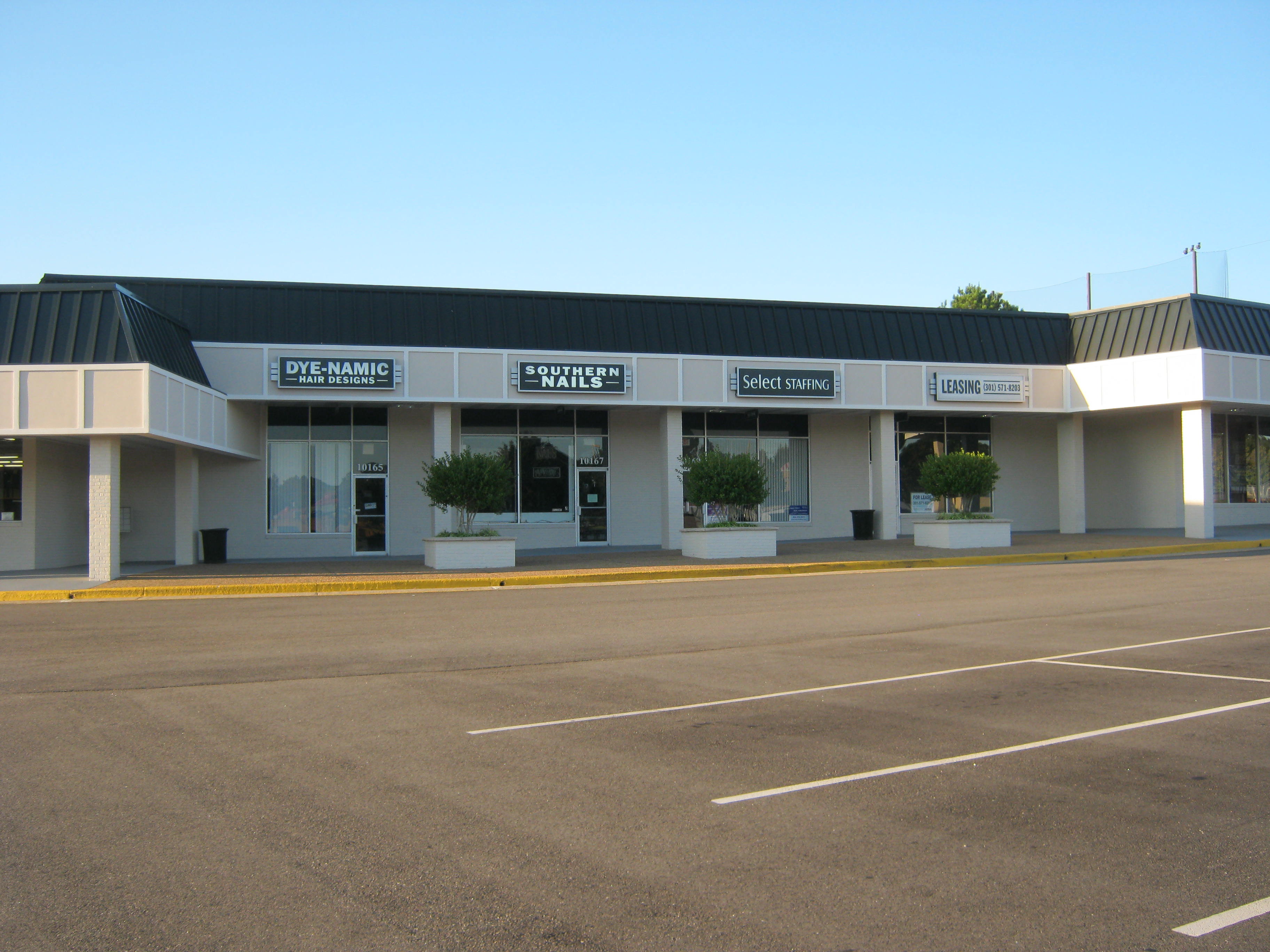
There was never much attention paid to the architecture of these strip shopping centers. The stores (and their signs) were left to figure out how to attract customers through marketing louder and louder. Convenient car parking ruled the day and kept the storefronts filled. The idea of designing a center that allows for layers of discovery and separation from the parking  was not considered. Pedestrian circulation we ignored as well as alternate forms of transportation. Stores are narrow and deep with no natural light.

We are now seeing developers that are focused on making the shopping experience more than just an anchor store and convenient parking. Attention to architectural details, outdoor gathering spaces, landscaping, and breaking up the parking into pedestrian friendly zones are bringing some shopping areas to the front as destinations. Customers are seeking out places to go where they can have a good experience. It is up to the developer to start that impression from the time the customer arrives at the shopping center to the time they enter the store / restaurant. This is impacted directly by design. Just slapping traditional elements on a “big box” is not enough. Careful thought and planning is required to make your project successful.

Your brand is more than your advertising. It should be reflected in everything associated with the company, including the physical spaces. By regularly auditing your building storefronts, you can ensure that your message is consistently and efficiently hitting your audience. Upgrading existing strip buildings and their parking areas, lighting and signage can reduce frustration, increase customer satisfaction, and help everyone feel safe and secure at your commercial property—thereby associating these qualities with the overall brand of the center and the individual brands of the tenants. Yes, storefront sign renovations at shopping centers is a smart thing to explore.

Have architectural design elements and signage at your retail property ever impacted your brand experience? Let us know in the comments. Thanks to the Gaines Group for this great article!


YOU MUST SEE THESE ARTICLES:


Architects Guide to Push-Thru Letters


Case Study: Renovation at Shopping Centers


Storefront Sign Renovation at Shopping Centers


4 Examples of Successful Electric Sign Upgrades


HOW CAN LIGHTING TURN TRAFFIC INTO CUSTOMERS? A Look at Sign Illumination Choices

www.holidaysigns.com-richmond-va-channel-lettersHOW CAN LIGHTING TURN TRAFFIC INTO CUSTOMERS?

A Look at Sign Illumination Choices

Red, Hot & Blue uses open neon tubing to attract hungry passers-by.

Red, Hot & Blue uses open neon tubing to attract hungry passers-by.

“Signage communicates through both conscious and non-conscious processes. Indeed signage may not only convey information and impressions – it may even persuade through non-conscious processing of design attributes,” says a recent University of Cincinnati study by Dr. James J. Kellaris and James S. Womack. This means the color, shape, size, and overall “personality” of your signs become major influences on people’s perception and recognition of your brand.

It is important to remember your signage is a 24-hour marketing tool that acts as your company’s personal sales representative as it makes first and hopefully lasting impressions on those who interact with it visually. Considering their high-profile street locations across Virginia and North Carolina, many of our clients realize this fact and have made investments in enhanced sign lighting effects netting positive results.

According to the American Sign Museum in Cincinnati, the first known illuminated sign dates back to 1840 when P.T. Barnum’s Museum was advertised by a gas-lit display. Gas lighting continued to be used by theaters, drug stores and other retailers until the electric lamp was introduced in 1881. The first electric signs used incandescent bulbs to make graphics similar to the way electronic LED signs do today. In 1910, the Great Chariot Race Sign in New York City was one of the most famous electrical displays in the world featuring a Roman chariot race simulating the movement of horses, drivers and whips at 2,500 flashes per minute and attracting crowds every night for years.

The bright Open-Face Neon letters in Bruce’s Body Shop are perfect for service shops


Neon lighting was developed in 1902 by a French scientist named Georges Claude. It was a popular choice for illuminated signs in the twentieth century and still is today. Although LED lighting has replaced many previous neon applications in signs due to costs of power and maintenance, there are still applications where neon is the best choice, making aesthetic statements that LED cannot achieve. Many restaurants choose open-faced neon channel letters and logos for their on-premise signage because neon lighting is bright, rich in color and creates a clean, crisp and inviting image. Neon or LED striping can also be implemented as borders on buildings and around traditional box signs for attention-grabbing effects.

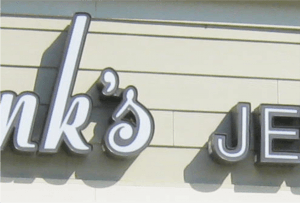
Today there are many choices for electric sign lighting and special effects. To portray a sense of quality, distinction and high value, some clients choose backlighting for their signs. This is where channel letter faces are constructed of a solid material and the lighting installed within the lettering bounces off the wall producing a halo effect. Fink’s Jewelers, a regionally-focused, multi-location retailer based in Roanoke, Virginia, chose LED backlighting for wall mounted channel letters in the example below.

Fluorescent lighting comes in both warm and cold tones and is traditionally used in sign cabinets with translucent faces. For special effects, the backgrounds can be opaque where only the lettering lights up at night. Similarly, the lettering can be raised from the background to create edge-lit push-thru graphics.

Back-lit Channel letters in Fink’s Jewelers produce a sense of quality, distinction, and high value

There are many ways to stand out among the crowd. One way is to influence buyers through special lighting effects. Holiday Signs has an experienced staff of designers, fabricators and installers who can produce effective custom lighting for your particular marketing application. For over 30 years our project managers have been involved with helping clients create just the right image to turn traffic into customers who understand your products and services before they walk through the door based on successful sign communications!

Contact: Mark Hackley, Account Executive mhackley@holidaysigns.com (540)416-3154


 printer friendly icon


Healthcare Communications – Augusta Health

www.holidaysigns.com-richmond-va-daktronics-watchfire-digital-LED-signsHealthcare Communications – Augusta Health Pharmacy & Lab

Fisherville, VA

hospital-main_entrance-150

Augusta Health, a privately owned and operated healthcare provider based in Fishersville, Virginia expanded its services by relocating its in-house pharmacy and laboratory to a site off campus with high traffic count and visibility. The building that would become the new pharmacy/lab was previously a bank. The hospital selected Holiday Signs to provide their new branding, wayfinding and digital messaging signage based on our past relationship and experience with helping the hospital with similar building conversion projects in connection with their off-campus expansion strategy.

The hospital administration and marketing staff were most concerned in having a remote system that could be updated and controlled from a central point in the main hospital offices. They were interested in a flexible yet secure system that would allow them to easily add new messaging signs as they continued to expand and market their services into other high visibility areas across the Shenandoah Valley Region.

Augusta Health EMC Picture

Working closely with Daktronics Inc., Holiday Signs was able to provide a digital messaging option with the architecture needed for growth. Venus 1500 Software was installed on two computers and messages can be relayed to any number of signs within the hospital’s secure network just as they would communicate with printers, fax machines, or other electronic devices on the system.

An antenna was installed on the sign that picks up signals from a transmitter inside the pharmacy that receives data from the marketing department. The sign has become an important communications tool and the hospital now has the means to capture the attention of a very captive audience year-round.

Contact: Mark Hackley, Account Executive mhackley@holidaysigns.com (540)416-3154


Printable PDF


Other Articles about Electronic Message Center (EMC) Projects:

Case Study: Towne Center West’s Digital Advertising Sign

Case Study: Green Top Sporting Goods’ Electronic Message Center on I-95

Using Co-op Dollars to Fund Digital Signage

Using Digital Signs to Connect with the Community

10 Reasons to Upgrade to On-Premise Digital Advertising

How Fresh Is Your Content?

How Fresh Is Your Content?

stale

We’ve seen them. Pictures on someone’s blog of a business advertising snow shovels in June or wishing you a happy Easter in August. But fresh content goes far beyond just making sure that what’s on your sign is relevant to the time of year.

So, what do we mean by fresh content? Sure, that oil change spacial has been up there for 2 years, but I’m still offering the special, right? Besides, that’s the same blue and yellow background I use for everything!

It’s easy to get into a rut by using the same fonts, backgrounds, graphics… Even the same specials. As passing motorists get used to seeing your sign, it tends to lose some of it’s ability to attract their attention. Especially if it’s the same basic color and shape of yesterday’s sign.

It’s good practice to sit down and take a good long look at your digital messaging at least once a year. Ideally, you would want to look at your messaging before the beginning of your busy season and again after the season to find out the effectiveness of messaging in achieving your goals.

Digital Message Centers are advertising. Would your business keep running a radio ad from last year just because you can’t think of anything better to put out there?

fresh

The first step in evaluating your message center effectiveness is to review your communication goals. We have to know what the sign is supposed to do before we can judge how well it’s doing it. Here are 4 basic goals you might start with:

  • Capture the attention of the audience
  • Convey information to the audience
  • Motivate action by the audience
  • Encourage repeat viewing by the audience

This is as basic as it gets: Are we getting the audience’s attention? Once we get their attention are we communicating our message efficiently? Are we converting that into action? Are we giving them a reason to look at our sign again in the future?

If your content is fairly static, choose one day from the last month and look over all of the messages that you displayed. Carefully look over the content and ask yourself the following:

  • Does the message present the information stylishly and succinctly?
  • Are we using good design rules when creating these messages?
  • Does content flow well from one message to the next?
  • Are messages consistent enough to convey brand identity while being varied enough to grab audience attention?
  • Are customers paying attention to our messages?
  • Are our messages influencing customer behavior?
  • Are we measuring the success of our messages?

One of the most challenging things to do is to present messages in such a way that the branding is consistent, yet the content is varied enough to continue attracting attention. One of the easiest ways to achieve this is to sit down and come up with sets of visual elements and backgrounds that work well together and rotate them on a regular basis.

Don’t confuse stale messages for continuity. Even you standard themes need to be updated periodically.

We recommend at least 4 themes for your sign that can be rotated quarterly as the season changes. Even adding seasonal elements to your current backgrounds and colors can do wonders for keeping your content relevant. Ideally, you should have 10-12 themes and change them out regularly for maximum impact.

Are you measuring the effectiveness of your digital reader board? It’s shocking the number of customers we work with who are unsure if their investment is effective or not. A simple way to determine the effectiveness of your messaging is to run promos on the board only and measure response.

Getting your customer’s attention is only half the battle. Keeping their attention is a constant battle that must be fought with hard work.